Lost in a Digital World? A Conspiracy of Cartographers
Blog Post 2: Visitor and Resident Map Activity
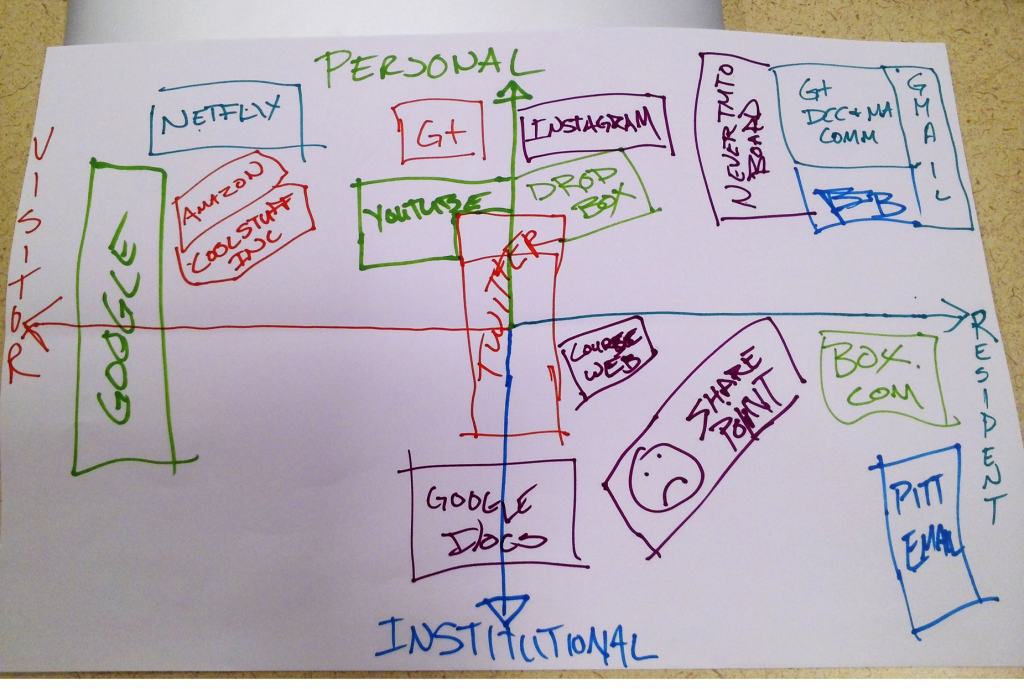
- Students will create their own personal Visitor and Resident Map (VandR map). You can see my map here: https://jamboard.google.com/d/1Tp4nRa7NlDNl-XJ48tY0DO8o7ncoZDmUbRrdgMiMUA8/edit?usp=sharing
- Students will also complete a reflection about how the VandR map can connect to ethical issues in teaching and learning , their educational ethical issue and the course outcomes.. More information about Visitor and Resident maps can be found at http://daveowhite.com/vandr/vr-mapping/
First, to explain the title of this post: It has no bearing on this assignment and it isn’t important or even all that interesting, but it’s my blog and I should get some enjoyment out of this too. That said, you may not have had the pleasure of seeing the film “Rosencrantz & Guildenstern Are Dead“, but I was required to read the book in English class (which means I watched the movie). It is based on a play inside the play Hamlet. There is a scene that I think about when the topic of maps comes up. In the movie, Rosencrantz and Guildenstern quip over the idea that England may not exist, but that it’s simply a “conspiracy of cartographers” (Watch the scene on YouTube).
As for the assignment itself, I think it was an interesting way to look at one’s personal and professional digital footprint(s). It would be a good exercise for a family or work team to look at what platforms each person is using to find common areas or to determine if another software or platform would be required for a given event or project. For example, in my family, we use What’s App rather than Facebook Messenger, not because of any preference for one over the other, but simply because my daughter works in law enforcement and will not/can not have a Facebook account for safety concerns.
I think it would be an interesting assignment to see if one person could fill out a V&R map about a second person using only open source intelligence (OSINT) gathering techniques and see how accurate it would be. It may also be a different perspective from someone doing it for themselves versus an outside set of eyes. This wouldn’t be very fruitful if the target had very little to no presence on the Internet, but for anyone with a public presence, a picture could be sketched.
The ethical implications I think come into play when you consider the digital trail of comments and artifacts that are left behind forever. Remembering that “delete” rarely really means delete when considering digital media and the Internet. Consider also that despite being cautious and meticulous about keeping your personal information private, information about you is being shared and tagged with meta data on your behalf all the time. Family, friends, and organizations are constantly putting up information about themselves, but often text or images of you are included and linked back to you. This is even happening retroactively as old newspapers and documents are being digitized and made searchable.
If you think data isn’t forever, jump into the Wayback Machine and explore the Internet Archive. It has more than 525 billion web pages saved over time. For example, check out the University of Calgary site in 1998 or 2001 or the University of Alberta in 2000. I can almost hear the v.90 modem screaming in the background. Flashbacks are everywhere. I even found a link to a broken version of my first “regular” classroom gig teaching Grade 5/6. I had eight years experience as a special needs TA and just came off 3 months in a Resource Teacher backfill. There was a full time Resource position available, but the belief at the time is everyone had to pay their dues in the regular stream first. I told them I shouldn’t be anywhere near a “regular” classroom, and by the end of the year, we agreed. I lost 20 lbs and most of my sanity that year. There was one PC in the classroom for the teacher to mark attendance and manage emails. They wouldn’t support computers for the students other than the obsolete and over booked lab, so I got a grant directly from the Province and bought 2 iMacs and a digital video recorder to do iMovies. They were pissed. The IT dept wouldn’t hook them up, so I came in one night and ran CAT 4 network cable through the ceiling tiles and spliced in a network switch to tap into the school network. They would have lost it, if they had ever found out. By the end of the year my Principal had shredded any future I might have had in that division and I had done my best to burn every bridge I could find. I didn’t go into teaching because it was working well. I went in to help the lost children like I was. My desk and I spent more time in the hall than in the classroom from grades 3-6. For a while in Grade 6 they were tired of looking at me, so I was sent to the book storage room for the majority of the days. I was perfectly happy and I never did finish all those worksheets.
The last thing I will note is that the V&R map visualizes the complexity of the Information Management environment that we operate in everyday for work and personal life. It is clear that we would never be able to manage this amount of information and systems without the assistance of Big Data and AI. For anyone who longs for a single platform or simple technical solution, I hope this exercise shows that that ship has sailed and we need to work on ways to work WITH data, not try to hide it under the digital rug because the bots will find it.
Hi Joel, in a previous life I taught research for fundraisers and part of the process was doing a mapping exercise of what type of information was available on someone online and examining the ethical issues in using “everything” that one might be able to find. Thanks for reminding me about this, I should add it to my blog this week!
Marcia
Thanks Marcia, The other thing to consider is that you can’t un-see or un-know something. Like in a court trial where the lawyer yells “objection” and the judge instructs the jury to “disregard the last statement”, the information has inevitably tainted the jury. When gathering information, is there any other reason than to use it to some advantage over the other person? But, is that knowing in itself unethical, or only if acted upon to the detriment of the target had you not known that information. Always provocative thoughts. – Joel