
What Would Greta Do?

Blog Post 4: Twitter Chat Activity
I created a Twitter account in 2011 basically to keep tabs on my then teenaged kids. In general, I rarely ever used it. I did enjoy following a specific hashtag from time to time while watching a live event. I think I watched the Grey Cup that year and enjoyed real-time comments about the game, but found no room for it in my daily life. In general, I haven’t found anything of substance that I had a personal or unique opinion about, and if I did, I had no interest in the opinions of the Twittervese on said topic.
More recently, I have returned to the world of education and to my surprise many teachers use Twitter quite heavily. Even those who don’t consider themselves ‘tech-savvy’ ofter maintain a presence on this social media. Ironically, many of these same teacher don’t have, and have no interest in maintaining, a LinkedIn profile which is a staple in business today. Not really understanding it, I did maintain a watch over the community to gather some intel and determine ‘who was who in the zoo’ as they say.
For the purpose of this course, I dusted off my Twitter handle and dove in head first into posting thoughts, following others, reaching out to authors of books I was reading, and generally getting a feel for things. In preparation of the Thursday Class Twitter Chat. I will say I find it a great source of information and new perspectives, but it comes at the cost of feeling overwhelmed and anxious. In my case it’s just the shear quantity of thoughts and I never get to truly finish one train of thought before I’m bombarded with something totally new. As with lots of things that feel out o control to start, they become common place with experience. There is a set of skills that will develop after repetitive use, like it was the first time you drove a car to today.
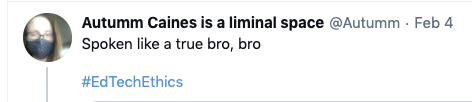
This went pretty well in my mind. There was a lot and I didn’t have time to read and interact with all of the tweets, but I did have a couple back and forth interactions with users outside of my circle and not members of the class. One such discussion resulted in me getting this response out of a stranger.
This experience reminded me of a story. A few years back, I was teaching a multi-day Project Management course to a group of professionals for the Canada School of Public Service. I was flown out to beautiful British Columbia and had a wonderful time with a great class. Several weeks after the course was over, I received the results of the survey that the participants completed at the end of the training. I received a comment from a student who felt I made her feel uncomfortable about her sexual orientation. I was shocked. I was upset and worried that I had done something unacceptable without realizing it. I contacted the supervisor of the school and asked about the complaint. I was informed that at some point in the course I said to the class “If you would open your hymnals to page 345 and please sing along”… This was one of those courses where the organization maintains the curriculum in house, the instructors are provided a pre-made powerpoint slide deck, and he students get a ‘workbook’ copy of the slides and exercises to use and take with them. Some students never open the book and some like to follow along and make notes, etc. I made a point of mentioning to the class the page number that corresponded with where I was with the instruction to make it easier for them to keep up. In this particular case, the individual heard my reference to the hymnal as an explicit nod to organized religion and deduced that I was not only a devout follower of religion, but that my zealous attitudes must include homophobia or at minimum a displeasure for people who choose alternate lifestyles and in turn was judging her throughout thus making her feel uncomfortable.
After hearing this, I was upset that this had happened and was sad that the woman had this negative experience based on my lame church service reference. I was relieved when the woman who was supervising the training said the response likely had little to do with what I said or did, but was linked to something much bigger outside of the classroom. This was reinforced years later when I heard a comedian talking about bad Yelp reviews and he said that a 1 star review followed by the obligatory two paragraph rant said more about the author’s insecurities than the restaurant’s quality.
All this is to say that interactions with strangers can easily go amiss simply due to the unfamiliarity of the participants. The woman in Vancouver had no way to know that I am actually an atheist and developed the hymnal reference as a barb toward the church and the distain I have for both religion and education’s sheep-like mindless workbooks and rituals. It also didn’t come into her consideration that I had no idea about nor care for her sexual orientation and actually had to reference a photo taken at the end of the course to remember she existed at all. So too it is unfortunate that “Autumm Caines is a liminal space” doesn’t know enough about me to lump me into the “bro” category, but decided to come in hard with a reference dripping in connotations of misogyny. This encourages me to think that something about me or my post triggered a previous set of circumstances where I was closely enough related to be categorized and treated like a group and not an individual. And. something about her use of “bro’ triggered me to resent the characterization and made me again question how my experience affects others.
This is just something I came across while researching Twitter’s history and thought I would share. If you like graphs, you will like this. Data Geeks Assemble: Visualizing Seven Years Of Twitter’s Evolution: 2012-2018
Access Granted
Social media succeeds in providing access from one person to another. Barriers such as geography and time, class and wealth, even intelligence all melt away to allow direct access to two or more willing participants. If I have an account and you have an account, I can say something and you might see it. Yes this is true for email and Facebook, but those media fail in reach. Akin to a party at a social club, there is lots of noise and too many people to meet and too many conversations to have them all. But, once you are in the room, you have access to people you may otherwise never get a chance to interact with. That said, access is just the first step. It takes courage and luck and a stiff upper lip to actually approach someone you may not know. Finally, you have to actually have something of interest and pertinent to say or you will be quickly replaced and have your feelings stepped upon. it takes patience and practice to be good at it, but at least it provides access.
I don’t like people and I sincerely dislike social situations that aren’t predictable and focussed away from me. I like to speak frankly and intimately and appreciate the option of making a fool out of myself in front of a targeted and deliberate audience rather than an unknown and everlasting parade of onlookers. I also dislike strong opinions and when forced to have on reserver the right to change my mind immediately and often. This type of digital permanence is unbecoming and is easily misinterpreted and appears disingenuous.
The use of social media in learning environments is fraught with problems. Don’t get me wrong, I think social media sites are essential tools for personal learning, but that wasn’t the question. Use of social media in institutionalized education is difficult because of the lack of structure and unpredictability. Each tweet is like throwing a boomerang while wearing a blindfold. It is an imprecise weapon to aim with very little control on how it comes back. However, if it is an authentic smack in the head you are looking for, then there is no better teacher (warning: user experiences may vary).
Nothing About Me, Without Me
I think, like statistics, machine learning and large data sets can be manipulated until the output fits a particular agenda. In statistics I like the saying “If you torture the numbers long enough, they will tell you anything you want”. This I think is my bigger point. It’s more about the implementation, and if it is intended to be fair and for the common good or to drive a particular outcome. I was reading this week’s article and couldn’t help think that this world was built on prejudice and discrimination, so why are we so surprised and outraged when technology is succeeding at automating and streamlining these processes? Very often, for example, the groups that are highlighting inequities in these algorithms are women and people of colour (especially African-American). There is a growing body of knowledge that demonstrates and validates their claims. In the very recent past, humans discriminated other humans into groups based on simple biological traits such as sex and race. Those two groups alone were legally considered property in the recent past. This wasn’t a time when members of these groups were lesser humans, they weren’t included in the category at all. Therefore overt and explicit acts against these groups was socially and legally acceptable. More recently, these groups have been included into the category of human and slowly gained more and more rights. As time has gone on, the clear cut categories of gender, sexual orientation, race, have blurred and greyed. However, this world continues to be fuelled by inequality, but the groups have shifted slightly to where groups are primarily socio-economic. The poor now have no rights, and the rich are beyond persecution. The group considered poor are now a mix of race, gender, religions, and so too the rich (though that demographic is pretty heavily still white, male). Is this progress? I guess it depends if you are rich or poor. If you are a woman or black and have become rich, this is progress. If you are a white male and have become disenfranchised, it is not. You only need to look as far as the USA right now to see this new paradigm playing out.
So, back to EdTech, mass data collection simple allows for humanity to be tracked and categorized in greater personalized detail and then discriminated for or against. Of course there will continue to be massive inequities in who get access to what opportunities in life, but to be fair, not everyone is socially, emotionally, or cognitively capable or interested in achieving. The education system (the System, not learning in general) has always been intended to sort humanity into categories and channel resources and opportunities to a given group as determined by the incumbent authority and in line with the prevailing social norms. In a capitalistic system, there just aren’t enough resources for everyone, so prioritization is required. Also, the artificial creation of haves and have-nots fosters the social tension which holds the system together. Yes, AI is in its infancy and needs lots of development before it is error free, but the majority of what people are citing as ‘problems’ have nothing to do with the technology or the math. If there is any progress, it is that a woman or a dark-skinned person has the possibility to be rich, famous, or whatever and a white male has the opportunity be wrongly convicted and subjected to mistreatment by authorities. The shift has been not that there was inequality and now there isn’t, rather it’s about who is on top and who is on the bottom. In most recent times, if you are born with means, you will likely have all of the advantages and if you are born poor, you will likely not experience the development needed nor the opportunities required to break that cycle.
This is a great discussion about “Scarcity Mentality”
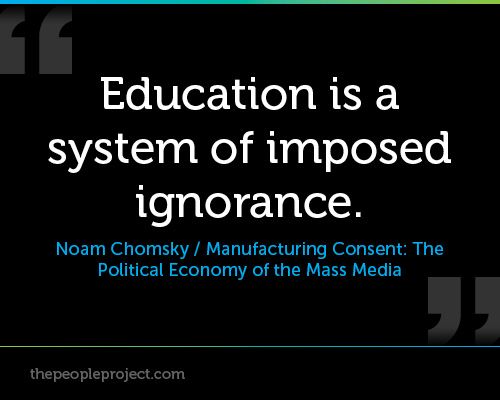
I think that before we can have an important and meaningful conversation about the role of technology in the education system, we must first understand the true essence of the system itself. ALSO, I think we need to differentiate the difference between the role of technology in life-long learning of an individual and that which happens in schools.
“Spoken like a true bro, bro.”
Resources:
Regan, P., & Jesse, J. (2019). Ethical challenges of edtech, big data and personalized learning: Twenty-first century student sorting and tracking. Ethics and Information Technology, 21(3), 167-179. https://doi.org/10.1007/s10676-018-9492-2